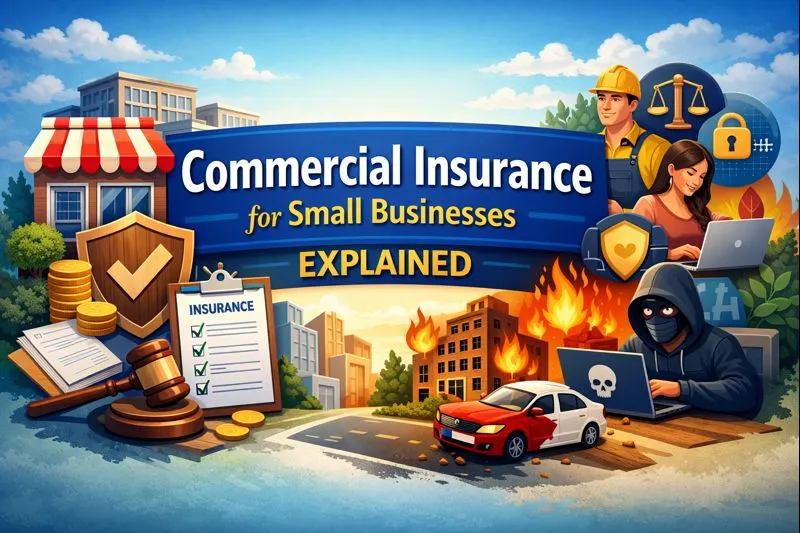
Commercial Insurance for Small Businesses Explained
Running a small business already gives you enough surprises. A customer slips in your store, a delivery driver damages a client’s property, a cyberattack knocks out your systems, or a storm tears through your office. Suddenly, the thing you built with years of work faces a bill you never planned to pay.
That’s where commercial insurance for small businesses comes in.
You don’t need every insurance policy under the sun. You need the right protection for the risks your business actually faces. And honestly, that distinction matters because nobody enjoys paying for coverage they will never use.
So, what does commercial insurance cover? How much does small business insurance cost? Which policies should you consider first? And how do you avoid paying for unnecessary coverage?
Let’s break it down without turning this into an insurance textbook.
What Is Commercial Insurance for a Small Business?
Commercial insurance gives your business financial protection against certain losses, accidents, lawsuits, property damage, and other risks. You purchase specific policies based on the nature of your business, your employees, your property, your customers, and your contracts.
Think of commercial insurance as a financial safety net for your company.
You still run the business. You still make decisions. You still carry normal business risks. However, insurance can help absorb certain expensive losses when something goes seriously wrong.
For example, imagine you own a small coffee shop. A customer trips over a loose floor mat and suffers an injury. The customer could demand compensation or file a lawsuit.
Your commercial general liability insurance may help cover eligible legal expenses, settlements, or judgments, subject to your policy terms and limits.
Now imagine a fire damages your coffee machines, furniture, inventory, and interior. Your commercial property insurance may help cover eligible property losses.
See the pattern?
Different policies handle different risks.
Why Small Businesses Need Commercial Insurance
Large corporations can sometimes absorb enormous losses because they have significant financial resources. A small business often cannot.
One major lawsuit could consume months or years of profit. One serious equipment failure could interrupt operations. One accident could create legal costs that dwarf the original problem.
That makes insurance more than another administrative expense.
The right coverage can protect your business cash flow, assets, reputation, and ability to keep operating after a major setback.
FYI, your personal insurance usually doesn’t automatically protect your business activities. Once you start selling products, serving customers, hiring employees, or using business property, you should review your insurance needs separately.
Commercial Insurance vs. Personal Insurance
This distinction causes plenty of confusion.
You might already have homeowners insurance, renters insurance, auto insurance, or another personal policy. That coverage doesn’t automatically extend to your business.
Suppose you run a graphic design business from your home. You use a laptop, printer, camera, and other equipment for client work.
Your homeowners policy might provide some limited business coverage, but you shouldn’t assume it covers every business-related loss. Policy terms, exclusions, limits, and business-use rules can vary significantly.
A dedicated business policy can address commercial risks more directly.
Personal Insurance Usually Protects Personal Risks
Personal insurance generally focuses on things such as:
- Your home
- Your personal belongings
- Your personal vehicle
- Personal liability
- Certain personal activities
Commercial insurance focuses on business-related risks.
That distinction becomes especially important when you:
- Serve customers at a physical location
- Store business inventory
- Employ workers
- Operate commercial vehicles
- Manufacture products
- Provide professional advice
- Handle sensitive customer information
- Sign commercial leases
- Work at customer properties
If your business activities create risks, your insurance strategy should reflect those risks.
The Main Types of Commercial Insurance for Small Businesses
You don’t need to memorize every insurance product available. Start with the policies that commonly matter to small businesses.
1. General Liability Insurance
General liability insurance often forms the foundation of a small business insurance strategy.
It can help protect your business against certain third-party claims involving:
- Bodily injury
- Property damage
- Personal and advertising injury
Imagine a customer visits your office and falls down the stairs. Or your employee accidentally damages a client’s expensive equipment while working on-site.
Those situations can create liability claims.
General liability coverage may help with eligible claims and legal expenses, depending on the policy.
However, general liability insurance doesn’t cover every business risk. It doesn’t magically transform into a universal “pay for everything” card. If only insurance worked that way.
2. Commercial Property Insurance
Commercial property insurance protects eligible business property against covered causes of loss.
Depending on your policy, that property might include:
- Buildings
- Furniture
- Equipment
- Computers
- Inventory
- Tools
- Fixtures
- Certain business documents
Suppose a fire damages your retail store. Property insurance could help you repair or replace eligible damaged property.
However, always check your policy’s covered causes of loss, exclusions, deductibles, limits, and valuation rules.
3. Business Owner’s Policy
A Business Owner’s Policy, often called a BOP, can combine several types of business coverage into one package.
A typical BOP may combine:
- General liability coverage
- Commercial property coverage
- Business interruption or related coverage
- Other options depending on the insurer and business type
Small businesses often choose BOPs because they can simplify insurance management.
A BOP can make sense for certain retailers, restaurants, contractors, offices, and other qualifying businesses.
However, not every business qualifies for the same package. A high-risk operation may need specialized policies instead.
4. Professional Liability Insurance
Professional liability insurance can matter greatly if your business provides advice, expertise, consulting, design, accounting, technology services, or other professional services.
Clients sometimes claim that professional mistakes caused them financial losses.
For example, imagine a consultant gives a client incorrect advice and the client claims that the mistake caused a major financial loss.
General liability insurance may not address that type of professional claim.
Professional liability insurance focuses on certain claims involving professional services, errors, omissions, or negligence.
Different industries use different names for this coverage. You may hear terms such as errors and omissions insurance, or E&O insurance.
5. Workers’ Compensation Insurance
If you employ workers, workers’ compensation deserves serious attention.
Workers’ compensation can provide benefits for eligible employee work-related injuries or illnesses. State laws generally determine workers’ compensation requirements, exemptions, and rules.
For that reason, you should check your state’s requirements rather than relying on a generic national rule.
Workers’ compensation can help protect employees while also addressing certain employer-related financial and legal risks.
If you hire even a small number of employees, don’t treat this coverage as an optional detail. Check your obligations before you start payroll.
6. Commercial Auto Insurance
Do employees drive vehicles for business purposes?
Do you deliver products? Visit customers? Transport equipment? Send technicians to job sites?
If yes, you may need commercial auto insurance.
Personal auto insurance policies can restrict or exclude certain business uses. A commercial auto policy can address eligible business vehicle risks.
Coverage can vary based on the vehicles, drivers, usage, limits, and policy terms.
If your employee uses a vehicle for business errands, don’t simply assume their personal auto policy covers everything. Ask your insurance professional before a minor delivery turns into a major headache.
7. Cyber Liability Insurance
Modern businesses depend heavily on technology.
Even a tiny company might store:
- Customer names
- Email addresses
- Payment information
- Employee records
- Login credentials
- Business documents
- Client data
A cyberattack, ransomware incident, data breach, or system compromise can create substantial expenses.
Cyber liability insurance can help address certain cyber-related losses and response costs, depending on the policy.
Coverage may include areas such as incident response, legal expenses, notification costs, data restoration, business interruption, and liability claims.
Cyber policies differ considerably, so don’t compare them based only on the premium.
8. Product Liability Insurance
Do you manufacture, distribute, import, or sell products?
Then product liability deserves attention.
A customer could claim that your product caused bodily injury or property damage.
Product liability coverage can help address certain eligible claims, depending on the policy.
For example, imagine a small company sells kitchen equipment. A customer claims that a defective product caused an injury.
That claim could create legal expenses, investigation costs, and potential settlement demands.
Product liability insurance can give the business another layer of financial protection.
How Much Does Commercial Insurance Cost?
Now we reach everyone’s favorite question: How much will it cost me?
Unfortunately, insurance doesn’t come with one universal price tag.
Insurers typically consider factors related to your business, operations, coverage needs, claims history, location, payroll, revenue, property, industry, and other risk factors.
Your final premium can also depend on:
- Coverage limits
- Deductibles
- Business location
- Number of employees
- Annual revenue
- Industry risk
- Claims history
- Property value
- Vehicle use
- Coverage options
- Policy structure
A small office-based consulting business may face very different risks from a construction company.
That makes broad online averages useful only as rough starting points.
What Can Lower Your Premium?
You can often reduce insurance costs by managing risk intelligently.
Consider:
- Installing security systems
- Maintaining equipment properly
- Training employees
- Creating workplace safety procedures
- Using strong cybersecurity controls
- Maintaining accurate business records
- Choosing sensible deductibles
- Reviewing coverage annually
- Comparing quotes from qualified insurers or brokers
However, don’t slash coverage simply to save a few dollars.
Saving $300 today doesn’t look clever if inadequate coverage creates a $100,000 problem later.
How Much Commercial Insurance Coverage Do You Need?
The answer depends on your business.
Start by identifying the risks that could seriously damage your company.
Ask yourself:
What could realistically put me out of business?
That question gives you a much better starting point than simply searching for the cheapest insurance quote.
Consider your:
- Property
- Equipment
- Inventory
- Employees
- Vehicles
- Customers
- Contractors
- Professional services
- Products
- Data
- Contracts
- Business income
Then consider the maximum financial impact of major incidents.
Pay Attention to Policy Limits
A policy limit represents the maximum amount an insurer may pay for covered losses under the applicable policy terms.
For example, a policy might provide a particular liability limit per occurrence and another aggregate limit for the policy period.
Don’t choose limits randomly.
If a customer contract requires specific limits, make sure your policy meets those requirements.
What Is a Deductible?
A deductible represents the amount you generally pay toward a covered loss before the insurer pays according to the policy.
Suppose your property policy has a $1,000 deductible and you experience a covered $10,000 loss.
You would generally handle the deductible first, while the insurer could cover the remaining eligible amount, subject to policy terms and limits.
A higher deductible can sometimes reduce your premium.
But ask yourself one practical question:
Could your business comfortably pay that deductible tomorrow?
If the answer makes you nervous, choose a deductible that fits your cash reserves.
How to Choose Commercial Insurance for Your Business
Choosing insurance doesn’t require a finance degree.
You just need a clear process.
Step 1: Identify Your Business Risks
Write down everything your business does.
Include:
- What you sell
- What you manufacture
- What services you provide
- Where you operate
- Who works for you
- What equipment you use
- What vehicles you operate
- What customer information you store
This simple list can reveal risks you might otherwise overlook.
Step 2: Check Legal Requirements
Your state or local government may require specific insurance depending on your business and employees.
Workers’ compensation rules provide a common example.
Some industries also face contractual or regulatory insurance requirements.
Check official requirements for your location and industry.
Step 3: Review Your Contracts
Commercial landlords, clients, lenders, vendors, and partners may require specific insurance.
A contract might require:
- General liability
- Professional liability
- Commercial auto
- Workers’ compensation
- Specific liability limits
- Additional insured status
- Certificates of insurance
Never assume your existing policy satisfies every contract requirement.
Read the requirements carefully.
Step 4: Compare Coverage, Not Just Prices
Getting three cheap quotes doesn’t automatically give you three useful options.
Compare:
- Coverage limits
- Deductibles
- Exclusions
- Covered causes of loss
- Endorsements
- Policy conditions
- Claims process
- Insurer financial strength
- Additional coverage options
The cheapest policy can cost more in the long run if it leaves major risks uncovered.
Step 5: Ask Direct Questions
Insurance language can make a simple idea sound like it needs a law degree.
Ask your insurance agent or broker:
- What does this policy cover?
- What does it exclude?
- What happens if a customer sues me?
- Does this policy cover work performed away from my office?
- Does it cover subcontractors?
- Does it cover my equipment away from the business location?
- What happens after a data breach?
- What limits should I consider?
- What deductible should I choose?
If someone cannot explain the coverage clearly, keep asking questions.
You’re buying protection, not a mysterious financial riddle.
Common Commercial Insurance Mistakes Small Businesses Make
Small businesses often make insurance mistakes because owners focus on immediate expenses.
Mistake 1: Buying Only the Cheapest Policy
A cheap policy can look attractive until you discover a major exclusion.
Price matters, but coverage quality matters more.
Mistake 2: Assuming General Liability Covers Everything
General liability can provide valuable protection, but it doesn’t cover every possible business loss.
Professional mistakes, employee injuries, cyber incidents, commercial vehicles, and other risks may require separate coverage.
Mistake 3: Forgetting Business Property
Your business may depend on computers, tools, machinery, inventory, furniture, and specialized equipment.
Make sure you understand how your policy treats those assets.
Mistake 4: Ignoring Cyber Risks
Small businesses sometimes think hackers only target huge corporations.
Attackers can target smaller companies because they may have weaker security controls.
Strong cybersecurity and appropriate insurance can work together.
Mistake 5: Never Updating the Policy
Your business changes.
Maybe you hired employees. Maybe you bought new equipment. Maybe you moved offices. Maybe you started selling online.
Your insurance should evolve with your business.
Review your policies whenever your operations change significantly.
Commercial Insurance for Different Types of Small Businesses
Different businesses face different risks.
Retail Businesses
Retailers may consider:
- General liability
- Commercial property
- Product liability
- Business interruption coverage
- Workers’ compensation
- Cyber coverage
- Commercial auto, where applicable
A store with valuable inventory needs a different insurance strategy from a consultant who works from a laptop.
Restaurants and Cafes
Restaurants can face risks involving customers, employees, food operations, equipment, property, deliveries, and alcohol service where applicable.
Common coverage considerations can include:
- General liability
- Commercial property
- Workers’ compensation
- Product liability
- Business interruption
- Commercial auto
- Cyber insurance
- Specialized coverage for specific operations
Contractors
Contractors often face job-site risks, equipment risks, vehicle risks, employee risks, and third-party liability.
Coverage considerations may include:
- General liability
- Commercial auto
- Workers’ compensation
- Equipment coverage
- Tools and mobile property coverage
- Professional liability for certain trades
- Bonds where contracts require them
Professional Service Businesses
Consultants, accountants, designers, technology professionals, and other service providers may face claims tied to professional advice or work.
They may consider:
- Professional liability
- General liability
- Cyber liability
- Business property
- Workers’ compensation
- Business interruption coverage
The key idea remains simple: match the insurance to the actual work.
Business Interruption Coverage: The Often-Overlooked Piece
Imagine a fire damages your office.
Your property insurance might help repair or replace eligible physical property. But what happens while your business stops operating?
You still have bills.
Rent may continue. Employees may need pay. Vendors may need payment. Customers may move elsewhere.
Business interruption coverage can help replace certain lost income or cover certain continuing expenses after a covered event, depending on the policy.
This coverage deserves attention because physical damage represents only part of the financial problem.
What Commercial Insurance Usually Does Not Cover
Insurance policies contain exclusions.
That means you should never assume that a policy covers every possible loss.
Depending on the policy, exclusions may involve areas such as:
- Intentional acts
- Certain professional errors
- Certain cyber incidents
- Certain environmental risks
- Certain employee disputes
- Wear and tear
- Certain natural disaster risks
- Specific contractual liabilities
- Uninsured vehicles or activities
Policies can also include conditions that affect coverage.
Read the exclusions and limitations before you need the policy.
Trust me, the worst time to discover an exclusion involves a five-figure claim sitting on your desk.
How to Save Money Without Gutting Your Coverage
You can manage insurance costs without turning your policy into Swiss cheese.
Start by understanding your actual risks.
Then consider:
- Bundle eligible coverage. A BOP may offer a practical structure for qualifying businesses.
- Improve workplace safety. Fewer incidents can help your overall risk profile.
- Strengthen cybersecurity. Better controls can reduce cyber risk.
- Review limits regularly. Avoid paying for coverage that no longer fits your business.
- Compare insurers. Different insurers may price the same business differently.
- Ask about discounts. Insurers may offer discounts based on qualifying safety or security measures.
- Choose deductibles carefully. Higher deductibles can reduce premiums but increase your out-of-pocket exposure.
IMO, the smartest approach balances reasonable premiums with meaningful protection.
How Often Should You Review Business Insurance?
At minimum, review your coverage annually.
But don’t wait twelve months if your business changes significantly.
Contact your insurance professional after events such as:
- Opening another location
- Hiring employees
- Buying expensive equipment
- Purchasing vehicles
- Adding a new product line
- Signing major contracts
- Expanding into another state
- Starting online sales
- Increasing revenue substantially
- Handling more sensitive customer data
A policy that fit your company two years ago may not fit today.
Questions to Ask Before Buying a Policy
Before signing anything, ask these questions:
Coverage Questions
- What risks does this policy cover?
- What risks does it exclude?
- What are the policy limits?
- What deductibles apply?
- Does the policy cover my specific business activities?
Cost Questions
- What premium will I pay?
- What factors affect the premium?
- Can I change the deductible?
- Does bundling reduce the cost?
- What discounts might apply?
Claims Questions
- How do I report a claim?
- What documentation should I keep?
- How quickly should I report an incident?
- Who handles the claim?
- What expenses might I pay myself?
Business-Specific Questions
- Does my policy cover subcontractors?
- Does it cover employees working remotely?
- Does it cover equipment away from my premises?
- Does it satisfy my client contracts?
- Does it cover business interruption?
- Do I need cyber liability insurance?
Good questions often produce better insurance decisions.
Commercial Insurance Checklist for Small Businesses
Before you finalize your coverage, review these areas:
- General liability
- Commercial property
- Business owner’s policy
- Professional liability
- Workers’ compensation
- Commercial auto
- Cyber liability
- Product liability
- Business interruption
- Equipment and tools
- Contract requirements
- State and local insurance requirements
You may not need every category.
The goal isn’t to collect insurance policies like trading cards. The goal is to identify meaningful risks and protect the business against losses you cannot comfortably absorb.
Final Thoughts: Get the Protection That Fits Your Business
Commercial insurance for small businesses doesn’t need to feel complicated.
Start with your risks. Identify your legal and contractual requirements. Then choose coverage that protects the assets, people, income, and operations that keep your company alive.
General liability can protect against certain third-party claims. Commercial property can protect eligible business assets. Professional liability can address certain professional claims. Workers’ compensation can protect eligible workplace injuries. Cyber coverage can address certain digital risks.
The right combination depends on your business.
Don’t buy coverage simply because another business owner bought it. And don’t reject important coverage simply because the premium looks annoying.
Ask yourself one final question:
If something went seriously wrong tomorrow, which loss could I afford—and which loss could destroy my business?
That answer can guide your insurance priorities.
And before you purchase or change coverage, talk with a qualified insurance professional and check the requirements that apply to your state and industry. Insurance policies vary, and your actual protection depends on the policy language, limits, exclusions, endorsements, and applicable laws.
A smart small-business owner doesn’t try to predict every disaster.
They prepare for the expensive ones.
Read More: ERP SaaS Implementation Steps Every Company Should Know
Tools: fybos.com